As German nation took form in the crucible of European wars and feuds, for a national narrative, Germans turned to India.

Germany – nation and nationalism
Part 1 -- Role of Napoleon
The German challenge to the Anglo-French hegemony in the WWI and WWII has obscured German history – especially related to its formation.
For modern Germany, a key event in history was Napoleon’s victory at Austerlitz (Dec. 1805). This ended Vatican’s role in Europe’s administration. The Holy Roman Empire, abolished in August 1806, after Austerlitz, added up to thousand varied kingdoms, principalities, duchies, counties, ruled by assorted kings, princes, dukes and counts, appointed by the Vatican. These included some three hundred independent German state-lets.
To buffer France from Austria and Russia, the French Republic under Napoleon initiated, what European history calls secularization, between 1794-1804. In the secularization process, the French Republic, under Napoleon, took away Church lands in the Rhine region. The administration of these acquired lands was handed over to neighbouring larger rulers. Smaller rulers who lost were compensated by a process called mediatization – or by war.
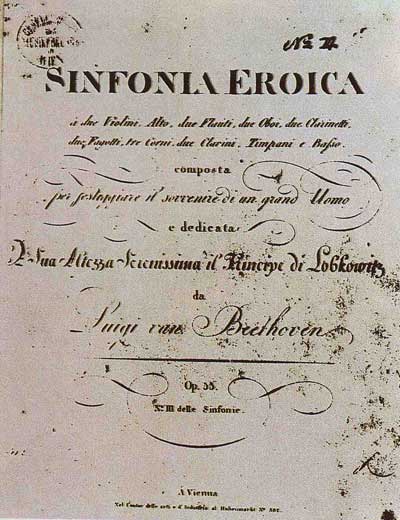
'Luigi van Beethoven had initially planned on dedicating the Eroica Symphony to Napoleon - till he crowned himself Emperor.
In this process of secularization and mediatization (1795-1814), a Confederation of the Rhine emerged in 1803, under Napoleon’s protection. Prussia remained independent. For this consolidation and ‘secularization’ of Germany, Napoleon was respected figure in Germany.
After Napoleon’s defeat (1815), the reorganization of European States by the Congress Of Vienna, led to a larger Prussia along with 38 other states, known as the German Confederation (Deutscher Bund; 1815–1866). Instead of being a French protectorate, this larger German Confederation (Deutscher Bund) was put into the Austrian Empire’s sphere of influence.
Part 2 -- Role of Bismark The Prussian initiative
While European powers were deciding the future of Germany, what was the climate in German lands?
The German volk themselves saw benefit in German independence and unification of the Kleindeutschland (little or “lesser”, Germany) with Prussian king or the the Grossdeutschland (Greater Germany). Popular support for this idea came in the Wartburg rally (1817), the Hambach Festival (1832) and the German revolutions of 1848. The Frankfurt Parliament attempted to create a German Constitution (March 28, 1849), which did not work out. German unification was attempted by Prussia under the Erfurt Union (1850), butstymied by the Russia and Austria.
Over a period of 100 years (1806-1906), Prussia turned from a principality to nation and morphed into Germany, creating the ‘Borussian Myth’ – Prussia, Borussia in Latin, as the saviour of the Germanic people. The role of Prussian armies under Marshal Gebhard Leberecht von Blücher, in Napoleon’s defeat at Waterloo (June 18, 1815), ensured that Prussian importance would only grow.
One Prussian played a key role in this.
The Prussian initiative – Bismarck unites
In 1862, Otto Von Bismarck enunciated the ‘iron and blood’ Realpolitik doctrine. R
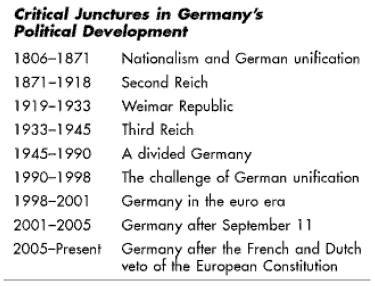
From: European Politics in Transition - Mark Kesselman, Joel Krieger, Christopher S. Allen, Stephen Hellman - Google Books 2012-02-24 14-59-13
To create Germany, Prussia had challenged and defeated major imperial powers of Europe.
First was Napoleon himself. The Prussian role, in the alliance of European powers at Waterloo, was crucial to Napoleon’s defeat.
After defeating Denmark (1864), the Prussians took on the largest European Empire – the Austro-Hungarian Empire. They too, were bested by Prussia in the Austro-Prussian War (1866). The French Empire, again after Waterloo, in the Franco-Prussian War (1870–71). This time the French Emperor was himself captured by the Prussian armies.
A unified and independent Germany under a Kaiser was ratified by the Treaty of Versailles of 1871 (26 February).
Part 3 -- Role of Archeology, Indology and Max Muller - The German narrative
What the Germans lacked was a narrative of their nation.
At the beginning of the 19th century, popular literary figures in German literature, like August von Kotzebue (1761-1819) were completely unconvinced about the German nation. With more than 200 plays to his credit, translated in at least 13 languages, popular in France, England apart from Germany, Kotzebue was a European phenomenon. For his disbelief in the idea of the German nation, at the Wartburg rally (1817), Kotzebue’s books were burnt by eager student German nationalists. Kotzebue’s cynicism provoked a German enthusiast, Karl Ludwig Sand to finally murder Kotzebue.
Even on the intellectual side, respected academics like Hegel thought that the German nation as ‘Gedankenstaat, a state which exists in thought and imagination alone, not in actuality.’ In yet another essay, Hegel sneered, “The vain idea known as the German Reich has disappeared.”
And this was not a German problem alone.
Ole Mother Hubbard
At the dawn of 19th century, European empires, found themselves with barren cultural cupboards.
World powers in their own right, with millions of slaves from Africa, after ‘successful’ genocides in Americas, swollen by hubris and military power across Asia, these European powers controlled capital flows of the world. Gold from the Americas, Australia, India and China gave economic depth to these imperial powers.
For these European empires, archaeology became a ‘playing’ ground.
The ‘Great’ Game
The new-born German nation also, needing ‘culture’, pushed other governments for excavation rights.
For the new-born Germany, the charge into archaeology, was a “national competition and a less belligerent realm for expression of resentment at Germany’s late leap into colonial activity.”Existing archaeological sites in Egypt and Mesopotamia (modern Iraq), apart from Italy, Greece, Turkey were already staked out by the Franco-British Empires. So, the German Emperor personally lobbied with other governments to obtain excavation rights in other countries.
For instance, in 1904, English archaeologist John Garstang (1876-1956) lost out to Hugo Winckler, ofDeutsche Orient-Gesellschaft, (German Oriental Institute) supposedly at the intervention of the German Emperor, Kaiser Wilhelm-II for excavation rights at modern Boghazkoy.
These rivalries had a telling effect.
Britons and Frenchmen almost monopolized Egyptian excavation in the 1880s and the 1890′s, but then Germans, Americans, and Italians came in. The turning point came in 1905-1907 with a rush of American expeditions and the founding of the German Archaeological Institute … In Istanbul and its Fertile Crescent provinces, German activity in the army and railroad building spilled over into archaeology. The director of Istanbul’s antiquities service and museum in the 1870s had been a German. German excavations at Pergammon in 1878 and later at Babylon and later at the Hittite capital of Boghazkoi fanned Frenchmen’s uneasiness …World War I aborted this promising beginning. German property in Egypt was sequestered. After the war, the dispute over Borchardt’s quiet export of the bust of Nefertiti to Berlin flared up. The Eyptians refused to allow German excavation or reopening of the German Archaeological Institute till 1929, when Herman Junker replaced the embittered Borchardt … he clung to his post until 1939 despite British accusations that he worked for the Nazis. (From Whose pharaohs?: archaeology, museums, and Egyptian national identityfrom … By Donald Malcolm Reid, pages 196-198; ellipsis, underlined text in parenthesis supplied. The rarely told complete story of Nefertiti’s bust.).
Germany alone, it is estimated, spent some four million marks, between 1899-1913 on excavations in the Middle East /West Asia.
After the founding of the Reich in 1871, archaeology became a national enterprise. The IfAK was taken over by the state, and eventually formed the basis of today’s Deutsches-Archaeologisches Institut. Rivalry with France and Britain extended to the scholarly realm, and resulted in governmental support for large-scale excavations by Ernst Robert Curtius at Olympia (1875-81), Carl Humann at Pergamon (1878-86), and eventually Robert Koldewy at Babylon (1898-1914) and Walter Andrae at Assur (1903-1914) in Ottoman Mesopotamia.[5] Wilhelm II was a particularly enthusiastic promoter of archaeology (pp. 192-199) …Archaeology abroad grew ever more dependent on the diplomatic and financial support of the Reich for massive long-term projects … German prehistorians of the early-twentieth century also maintained that their countrymen represented the purest modern descendants of the ancient Aryans. Thus they contributed to the witches’ brew that would make up Nazi racist ideology.
Truth is stranger than fiction
Competition from Germany was especially very galling for the Anglo-French archaeologists and historians. Hollywood’s portrayals of the ‘German archaeologist’, even today are proof of this. Hollywood could not keep its hand off such a juicy set of characters and incidents.
To this odd and motley crowd of British, French, German and Italian archaeologists, add a character like Sheikh Hamoudi, and you have all the characters needed for a Hollywood potboiler – the Indiana Jones series.
Vendyl Jones, James Henry Breasted, Robert Braidwood, Hiram Bingham III and Roy Chapman Andrews became a mashed up Indiana Jones. For villainy, Hollywood drew upon German archaeologists like Hermann Junker (German archaeologist will do anything for artifacts), Otto Rahn (SS officer after Holy Grail), Ludwig Borchardt (German archaeologist ships home ‘stolen’ artifacts).

From: Christian examiner, Volume 78; Source and courtesy - books.google.co.in
German archaeologists became cannon fodder to build a Hollywood caricature as a villain – as Indiana Jones’ protagonist.
What gave this competition a cutting edge, was the Aryan ‘legacy’ that the Germans ‘discovered’.
For this idea of an Aryan nation, Germany turned to India.
Mise-en-scène
Many Germans played a crucial role in this development.
A pioneer in this was Friedrich Schlegel in 1808, whose book Über die Sprache und Weisheit der Indier (On the Speech and Wisdom of the Indians, Heidelberg, 1808) created the Aryan ‘industry’.
August Schlegel, a professor of literature at the University of Bonn from 1818, pursued oriental studies, and set up a Sanskrit printing centre. Between 1823-1830 he translated the Bhagavad Gita in Latin (1823), the Ramayana (1829), the Indische Bibliothek journal – with Reflections on the Study of the Asiatic Languages in 1932. The Swedish crown prince used August Schlegel’s services as a secretary from 1813-1817.
With August Schlegel, was Christian Lassen, who co-wrote a critical, annotated edition of Hitopdesain 1829-1831. His biggest work was possibly the Indische Altertumskunde (Indian Archaeology), originally in four parts, during 1847-1861.
Baron Alfred von Gutschmid was another Orientalist who contributed to India and Sanskrit studies. Albrecht Weber’s was active in both Sanskrit and German politics .
The other leading light in Germany was Franz Bopp – author of Über das Conjugationssystem der Sanskritsprache in Vergleichung mit jenem der griechischen, lateinischen, persischen und germanischen Sprache (On the Conjugation System of Sanskrit in comparison with that of Greek, Latin, Persian and Germanic) in 1816, which was followed with many works on comparative grammer – between Sanskrit and other languages. Earlier, in 1812, the Bavarian government, financed Bopp for a study trip to Paris, in Sanskrit. There, in Paris, he joined eminent men such as Antoine-Léonard de Chézy (one of his instructors), Louis Mathieu Langlès, Silvestre de Sacy.
Georg Friedrich Creuzer, a professor of philology and ancient history at Heidelberg, did not endear himself to many, when in 1810-1812, he published Symbolik und Mythologie der alten Völker, besonders der Griechen. Going into 3 editions, Creuzer suggested that behind Homer’s and Hesiod’s mythology were Eastern sources. These ‘sources’ were the pre-Hellenic natives in Greece, the Pelasgians.
The Grassmann brothers, Hermann and Robert were active in German politics – especially during the 1848-1850 period. Hermann Grossmann’s translation of the Rig Veda is still in print. He was also a significant mathematician – which was usually dismissed as incomplete and inadequate presentation. It might be interesting to investigate, how much Hermann derived from Vedic mathematics – which would account for incomplete and inadequate presentation.
The three volume catalogue of Sanskrit manuscripts, Catalogus Catalogorum, published between 1891-1903, documented the huge mass of writings in Sanskrit – by Theodor Aufrecht who was not active in German politics.
In Paris, there was Alexander Hamilton, the linguist (1762–1824), a British cousin of Alexander Hamilton, the U.S. Secretary of State for Treasury, under George Washington. In Paris, studying and writing on Sanskrit, Hamilton was for sometime tutor to brothers Schlegel – and assisted Charles Wilkins in translating the Hitopdesa.
There were other Sanskrit scholars and Indologists – whose contribution to German statehood was however minimal. For instance, sponsored by the Russian government, Otto von Böhtlingk (May 30, 1815 – April 1, 1904) a Russian-born, German Indologist and Sanskrit scholar, translated Pannini’s grammer, worked on a Sanskrit dictionary for some 23 years, in collaboration with Rudolf von Roth.
All these scholars were supported by their respective governments – August Schlegel by Prussia, Bopp by Bavaria, for instance. In 1885, Richard Garbe, a German professor at the University of Tübingen, was funded by the Prussian Government, for a trip to India.
Curiously, in India
The best known German Indologist of all time, Friedrich Max Mueller (1823–1900), is famous for never having set foot in the country that he studied and romanticized all his life.
Max Muller’s big role in all this was being the source of manuscripts. Many like William Dwight Whitney supported Max Muller, ‘because Muller’s access to manuscripts in England could prove useful to scholars such as himself’ – and he favoured those German Indologists who toed his line.
Duncker’s Aryan invention
Tying this output together, as a unified story, was an early attempt at creating a German history by Maximilian Wolfgang Duncker (1811-1886). From the publishing family that owned publishing houseDuncker & Humblot,
Duncker’s history books started appearing in 1834 – with his Latin publication – De historia eiusque tractandae varia ratione (Translation – Treatment of Rationale for History). Duncker was a member of the Frankfurt National Assembly (1848-49) for the Halle electoral district. Duncker was active in the Gotha Nachparlament (1849) and also at the Erfurt Union Parliament (1850).
In 1852, his Geschichte des Alterthums (Translation – History of antiquity) went into reprints and a recent edition has been re-published. His Vier Monate auswärtiger Politik: Mit Urkunden(Translation – Four months of foreign policy: with documents) sparked a criminal case against him. His 1850 work Die Männer der Gegenwart: neue Folge. Heinrich von Gagern : eine biographische Skizze ; neue Folge (The men of the present: new sequence. Heinrich von Gagern: a biographical sketch; new episode in English).
Duncker compiled the considerable German academic activity in history and philology, to build an extensive narrative, drawing linkages from Greece to India. Using work of eminent Orientalists of their time, like Christian Lassen, Alfred Gutschmid, Duncker’s work preceded Hume’s work.
Duncker as a part of a publisher family, well-connected to the administration, meant he could draw upon the finest German minds of his time. For instance, Duncker shared his bachelor quarters with philologist August Friedrich Pott (1802-1887), an expert on Gypsy Romany language. Potts took care of Duncker, during this period, while he recovered from a bout of typhus.
Another of Duncker’s associate was Droysen (Johann Gustav), whose authoritative book on Alexander The Great, Geschichte Alexanders des Grossen (History of Alexander the Great), (Berlin, 1833 and other editions) pioneered the trend of equating power with greatness. Thomas Carlyle was to subsequently define “history of the world is but the biography of great men”. In Duncker’s inner circle was Hermann Baumgarten, an uncle of Max Weber.
Close to the administration, Duncker occupied various positions of great intellectual influence. Notably, he was the advisor to the Crown Prince, Friedrich Wilhelm (1831–1888) – later to Emperor Friedrich-III – for 99 days.
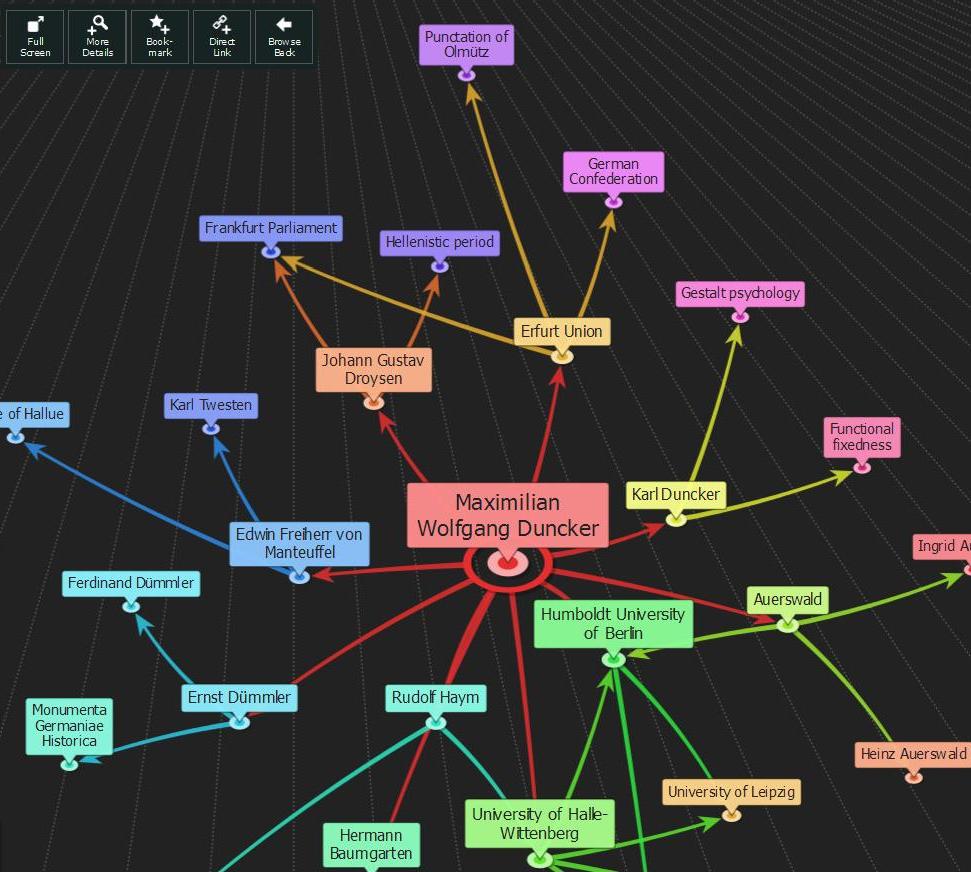
Maximilian Wolfgang Duncker - His work, position and activity brought him into contact with the movers and shakers of Germany. | Mind map by InfoRapid Knowledge Portal on 2012-02-25 at 10-17-08 | Click for a larger image. For interactive image source, shortlink ishttp://goo.gl/ZImBg
But Duncker’s biggest contribution to German ‘story’ was his Aryan narrative.
Max Duncker’s conversion ofYavana king Bhagadatta, to Greek king Apollodotus is at best fanciful. Duncker writes,
from the mention of the Yavanas as the allies of the Kurus, and Dattamira, i. e. Demetrius, the king of the Yavanas. This king reigned in Bactria in the first half of the second century b. c. (Lassen, loc. cit. 1, 557). Another king of the Yavanas who is mentioned is Bhagadatta, i. e. apparently, Apollodotus, the founder of the Grseco-Indian kingdom in the second half of the first century B.C. (Von Gutschmid, ” Beitrage,” s. 75).Apollodotus, Apaladata on tho Arian legends of his coins, is no doubt the Bhagadatta of the Mahabharata, just as the Dattamitra there mentioned is Demetrius ; Vol. IV. p. 80, n. Among the Indians Menander appears in the form Milinda.
This invention by Duncker has continued from nearly 1860-2010 – for 150 years.
In Mahabharata, the Yavana king Bhagadatta’s
Also, Bhagadatta is clearly an important and historical character. Ruling families in Assam, North East trace their lineage to Bhagadatta.
‘Aryan’ history becomes fashionable
At the start of twentieth century, there were swarms of people wanting to study ‘Aryan’ history. Along with cultural dacoits like Augustine Waddell, Auriel Stein, there were the more academic types who wrote a book on India and ‘Near East’ – Nejstarší dějinyPřední Asie a Indie by Bedřich Hrozný.
By the 1920′s under a deluge of archaeological evidence, it appeared that Indian history would run away from its rulers – the British Colonial Raj.
Usurping Aryan Achievements
Aryan history of languages, culture, spread of civilisation, its science and technology appealed to many in the West – and especially White Supremacists.
One hilarious example of this kind Charles Morris, writer of The Aryan Race: Its Origins And Its Achievements. If this book was not a best seller, as ‘history’, it would surely have been best seller as a comedy. Another book – based on the Aryan Invasion Theory, was Lectures of the Arya by Albert Pike.
A set of books written by L. Austine Waddell – again had a single point agenda of usurping Aryan achievements and culture. Wadell declared, “the Aryan Race — now chiefly represented in purest form in North-western Europe.”
One of the first big hits from Hollywood was the 1915 film, DW Griffith’s ‘Birth Of A Nation’. This film on the ‘Knights of the Ku Klux Klan’ enjoys cult status. D.W. Griffith’s film The Birth of a Nation was based on a book by Thomas Dixon, Jr. titled The Clansman – An Historic Romance of the Ku Klux Klan, written in 1905. Dixon thought (from the book preface) that the rise of the Ku Klux Klan (KKK) was the “most dramatic chapters in the history of the Aryan race.” Later, this piece of racism was replaced by another phrase – “Carpetbaggers’ political folly” in the film. In the climactic scene, these KKK knights ride to the rescue of the Whites from North and South, to the blaring sounds of Wagner’s‘Ride of the Valkyries.’
Yes, the same music – Wagner’s ‘Ride of the Valkyries.’
The common enemy of the united ‘Aryan Whites’ is the liberated black soldier. The original screen title gives the viewer the message: “The former enemies of North and South are united again in common defense of their Aryan birthright.” Remember, this was during WW1.
Thomas Huxley, the British biologist, known also as ‘Darwin’s Bull-dog’ in “The Aryan Question,”published in the Nineteenth Century Magazine, 1890, page 766:—
“There was, and is, an Aryan Race, that is to say, the characteristic modes of speech, termed Aryan, were developed among the Blond Longheads alone, however much some of them may have been modified by the importation of non‑Aryan elements.”
After, WWII, it became politically incorrect for any White to call themselves as Aryan. That has not stopped White Supremacists, mainly gangs in USA, from calling themselves Aryans.
Today, the Jewish genocide is being blamed on ‘Aryan’ superiority – although, Europe has healthy and living tradition of anti-Semitism of more than 500 years. Evidently, in the land of the Aryans (India), the lack of religious persecution is not relevant. The precedent of Australian Aboriginal and the Native American genocides, Europe’s parallel, are ignored.
Greek Miracle vs Aryan achievements
While Britain and the France, for colonial reasons, were ‘discovering’ the Greek miracle, Germany and the USA started ‘discovering’ the ‘Aryan’ roots’ to Western civilization.
Martin Bernal, author of ‘Black Athena’ trilogy, analyzes Western “amnesia” towards African contribution to Western culture. His thesis traces this ‘amnesia’ to the replacement of Europe’s “Ancient Model” (Egypt-Greece-Rome model) of historiography with the “Aryan” (India-Mesopotamia-Babylon-
Simply speaking, the West replaced Egypt as the source of culture with the Aryans. Fact is, neither the cultural achievements of Egypt (from Africa) nor of the Aryan (from India) are for the West to arrogate to themselves.
A writer on this phase of history, Susan Marchand says,
“The Aryan industry, of course, burgeoned. Even the former Kaiser Wilhelm II, in exile, took up the study of the Orient … In a 1928 letter to his friend, the former emperor reported a recent conversation with Oswald Spengler in which Wilhelm had tried his best to convince the herald of Western doom that “we are orientals [Morgenländer], and not westerners [Abendländer].”
With Germany and America on the Aryan train, Britain was hard pressed to control Indian historiography. ‘Fresh’ evidence was needed to show ‘Aryan’ invasion. Indus Valley civilizationprovided that opportunity.
The task became easier, as Germany lost WWI, and the Ottoman Empire was carved out of existence. The rump state of Turkey went down the ‘Westernization’ path. Neither Germany or Turkey were in any position to oppose Anglo-French historiography. The Egypt-Greece-Rome-Europe axis dismissed the ‘Aryan model’ archaeologists as pan Babylonists. Colonialists have resisted changefrom the Egypt-Greece-Rome-Europe world view – which was called in question by the excavations and study by Friedrich Delitzsch, Alfred Jeremias, Peter Jensen, Eduard Stucken and Hugo Winckler, whose work has been obscured.
After WWII, the USA no longer supported the ‘Aryan’ model.
German industry gained rapidly after unification. German economy soon challenged Britain and France in industry and technology – without the benefits of the colonies. The Franco-British relationship was settled into an easy duopoly, by the time the German nation emerged. Spain was already an empire in decline and irrelevant to Europe’s power equations. The Dutch, Italians, Danes had accepted their role as junior partners.
That left Germany to confront Britain.
And also, note, Hitler’s name has not been used even once.


